
5G battery drain is one of those things people repeat as fact without ever actually testing it themselves. I’d heard the same claim for years — 5G kills your battery, switch to LTE to save power — but had never once checked whether it was true on my own phone, in my own city, with my own carrier.
So I ran a real comparison: one week with 5G on, one week forced onto LTE only. Here’s where the difference actually showed up, and where it turned out to barely matter.
What 5G Actually Changes Compared to LTE
5G isn’t one single technology — it covers a range of frequencies with very different real-world behavior, which is part of why people’s experiences with it vary so much.
- Low-band 5G covers wide areas similarly to LTE, but usually isn’t dramatically faster
- Mid-band 5G is what most people actually experience day to day — noticeably faster than LTE with reasonably wide coverage
- mmWave 5G delivers the fastest speeds by far, but only over very short distances, often just a city block or two, and struggles to pass through walls
Battery impact isn’t uniform across these either. A phone constantly switching between 5G and LTE as signal strength changes tends to use more power than one staying on a single, stable connection, regardless of which one it is.
The One-Week Test: 5G On vs 5G Off
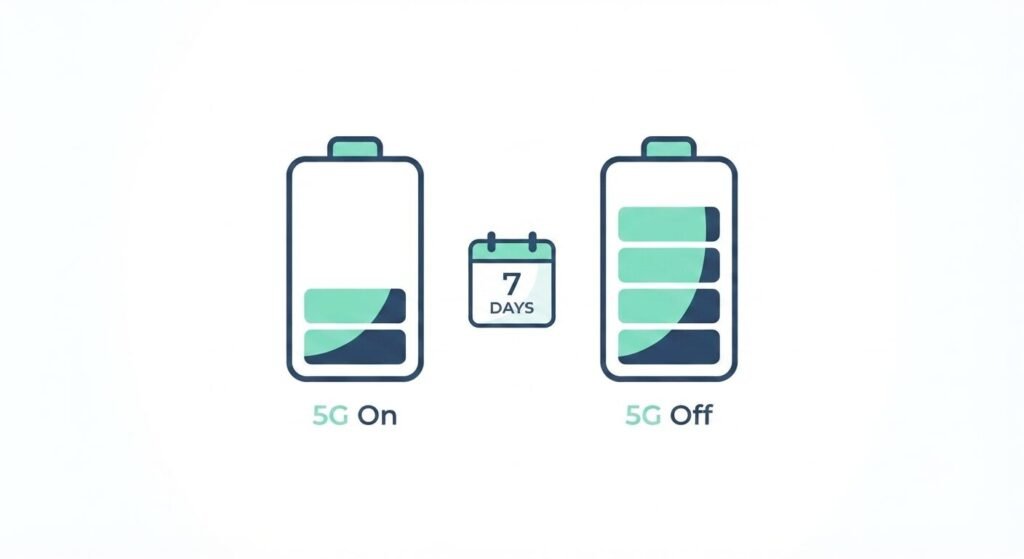
I used the phone identically both weeks — same apps, same screen time, same locations for most of the day — and compared battery health and data usage reports at the end of each.
Week one, 5G on: Battery life was slightly shorter on average, most noticeably on days spent moving between areas with inconsistent 5G coverage rather than staying in one spot.
Week two, LTE only: Battery life improved modestly, and the difference was most obvious specifically during commutes and errands, not while sitting at home or in the office on Wi-Fi.
The gap was real, but smaller than the “5G kills your battery” claim usually implies — and it wasn’t consistent throughout the day.
Where the Difference Showed Up (and Where It Didn’t)
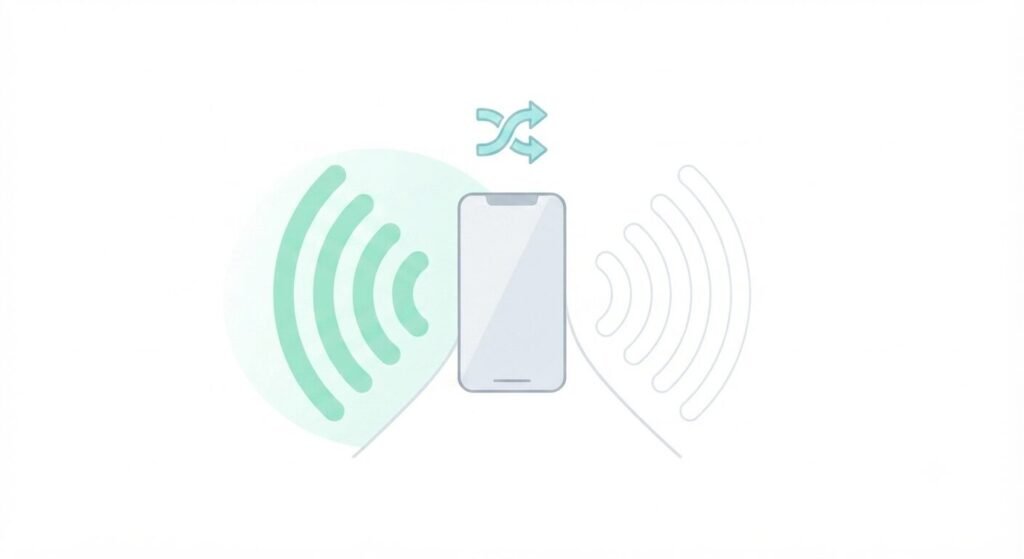
Showed up: Moving through areas with patchy 5G coverage, where the phone kept switching between 5G and LTE searching for a stronger signal. This constant switching, not 5G itself, turned out to be the actual drain.
Didn’t show up: Sitting in one place with strong, stable 5G coverage — at home, at a desk, anywhere the connection didn’t need to hunt for a better signal. Battery drain in these conditions was close to identical between the two weeks.
Showed up differently than expected: Download and streaming speeds were meaningfully faster on 5G in mid-band coverage areas, which matters more for anyone regularly downloading large files or streaming video on the go rather than mostly using Wi-Fi.
If overall battery life has been a bigger concern than this one specific setting, my phone battery guide covers the habits that tend to matter more across an entire day.
When Turning Off 5G Actually Makes Sense

Based on the test, forcing LTE only makes the most sense in specific situations rather than as a permanent setting.
- Worth turning off: During travel through areas with known spotty 5G coverage, or on a day when maximizing battery life matters more than speed
- Not worth turning off: At home, at work, or anywhere with consistently strong 5G — the battery difference in stable coverage was close to negligible
- Also worth checking: Data usage, since 5G’s faster speeds can make it easier to burn through a data plan faster without noticing — I covered where that usage tends to hide in my mobile data guide
Frequently Asked Questions
Does 5G always drain the battery faster than LTE? Not consistently. The bigger factor is how often the phone switches between 5G and LTE chasing a signal, which happens far more in areas with inconsistent coverage than in places with strong, stable 5G.
How do I turn off 5G on my phone? On iPhone: Settings → Cellular → Cellular Data Options → Voice & Data, then select LTE. On Android, the exact path varies by manufacturer, but it’s typically under Settings → Network & Internet → SIM → Preferred network type.
Will turning off 5G make my internet noticeably slower? In mid-band or mmWave coverage areas, yes, especially for large downloads or video streaming. In low-band 5G areas, the speed difference compared to LTE is often smaller than people expect.
Does 5G use more mobile data than LTE for the same activity? Not inherently — the data used for a given task like streaming a video is roughly the same regardless of network type. The difference is that 5G’s speed makes it easier to stream in higher quality or download more without noticing the increased usage.
The Real Difference
5G battery drain turned out to be less about the technology itself and more about signal stability — a phone constantly switching networks in patchy coverage areas drains faster than one sitting on a strong, consistent connection, 5G or otherwise. For most people in areas with solid coverage, leaving 5G on and reserving LTE-only mode for specific low-coverage situations makes more sense than switching permanently.
📍 Read Next: If overall battery life is still the bigger question, I Killed My Last Phone’s Battery in 14 Months covers the habits that made the most difference for me long-term.