
I added a metal plate to my phone case for a magnetic car mount last year, and it wasn’t until months later, sitting on a wireless charging pad overnight, that I noticed the phone was warmer than usual and the charge hadn’t gone anywhere close to full by morning. The car mount and the wireless charger had never been used at the same time before, so I hadn’t connected the two. Once I did, I went looking for a clear answer on whether you can use a MagSafe charger with a metal plate in the case at all — and most of what I found either oversimplified it or contradicted itself, so this is an attempt to lay out what’s actually going on.
Why This Combination Causes Problems

MagSafe charging relies on a ring of magnets inside the iPhone lining up precisely with a matching ring of magnets in the charger, which keeps the coils aligned for efficient power transfer. A metal plate sitting between the phone and the charger — even a thin one — can interfere with that magnetic alignment, since the plate itself reacts to the magnets and can throw off how cleanly the two rings snap into place.
Separately from alignment, wireless charging works by generating an alternating magnetic field that induces current in a coil inside the phone. A metal plate sitting in that field can also have current induced in it, which turns into heat. Most wireless charging systems, including MagSafe, include a safety feature commonly called foreign object detection, designed to sense exactly this kind of interference and stop or limit charging rather than let something overheat unsafely. That’s a deliberate safety behavior, not a malfunction — the charger doing its job correctly can look, from the outside, like it’s simply failing to charge the phone.
Not All Metal Plates Are the Same

The type of metal in the plate matters a lot here, and it’s the part most explanations skip. Magnetic car mounts need to grip the plate with an actual magnet, which generally requires a ferrous metal — the kind of metal that magnets are strongly attracted to. Non-magnetic metals wouldn’t hold a magnetic mount securely in the first place, so most generic metal plates sold for this purpose are the ferrous type, and that’s exactly the type most likely to interfere with magnetic alignment and be affected by induced current.
Accessories specifically labeled as MagSafe-compatible are generally designed with this interaction in mind, which is why they’re often built and marketed differently from a plain generic metal plate — but the exact way any individual product avoids the problem varies enough between manufacturers that it’s not something to assume without checking the specific product’s own claims.
What Actually Happens When You Try It
Based on what I ran into and what shows up consistently in other people’s accounts of the same setup, the outcome tends to fall into one of a few patterns: charging fails to start at all, charging starts but stops shortly after as the safety feature kicks in, or charging continues but the phone runs noticeably warmer and slower to charge than it would without the plate in place. Which of these happens seems to depend on the specific plate, its thickness, and exactly where it sits relative to the coils — which is also why some people report no issue at all while others run into it immediately.
How to Tell If Your Case Is the Problem

Before assuming the charger itself is broken, a few checks help isolate whether the metal plate is actually the cause:
- Try wireless charging with the case and plate removed entirely. If charging works normally without them, the plate is very likely involved in whatever was happening with it in place.
- Check whether the phone gets warm quickly after placing it on the charger, rather than gradually. A fast, early temperature rise lines up more with induced current in nearby metal than with normal charging behavior.
- Look at whether charging starts and then stops on its own, rather than never starting at all. That pattern is consistent with a safety feature interrupting the process after detecting an issue.
- Check the plate’s specific description or listing for any mention of wireless charging compatibility one way or the other, since some products do state this directly.
What to Actually Do About It
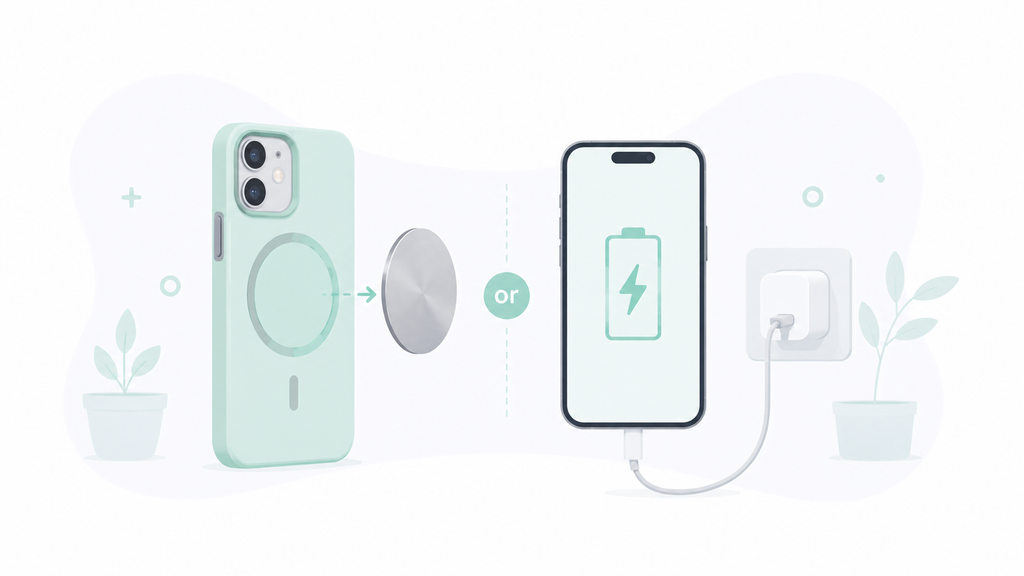
If the diagnostic steps point to the metal plate as the cause, here’s what actually addresses it:
Remove the plate before wireless charging, if it’s designed to be removable. Some plates are meant to sit inside a case pocket specifically so they can be taken out, which sidesteps the issue entirely without giving up the car mount setup.
Use a wired charger instead of wireless charging when the plate is in place, if removing it regularly isn’t practical. A cable connection isn’t affected by the magnetic interference or induced current issue at all.
Look specifically for a mount or plate marketed as compatible with wireless charging, rather than a generic magnetic plate, if a permanent solution is the goal — and check that specific product’s own claims rather than assuming compatibility based on the category alone.
Don’t assume a charger is defective just because it stops working with the plate in place. Testing without the case and plate first, as in the checklist above, is worth doing before returning or replacing anything.
Frequently Asked Questions
Will a metal plate in my case damage my phone’s wireless charging? It’s more likely to interrupt or slow charging than to cause lasting damage, since the safety features built into wireless charging are specifically meant to stop charging before things get to a damaging point.
Do all magnetic car mount plates cause this issue? Not necessarily every one, and how noticeable the effect is seems to depend on the specific plate’s thickness and metal type, which varies by product.
Can I just remove the plate when I’m charging wirelessly? Yes, if the plate is designed to be removable — many magnetic mount systems specifically allow this, which avoids the issue without giving up the car mount setup entirely.
Does this affect wired charging too? No — wired charging doesn’t rely on the magnetic field or coil alignment that causes this issue, so a metal plate in the case shouldn’t interfere with it.
The Real Difference
The core issue with using a MagSafe charger with a metal plate in the case isn’t a single failure — it’s two separate effects, magnetic alignment interference and induced current heating, that can show up together or separately depending on the specific plate. Removing the plate before wireless charging, or switching to a wired charger when that’s not practical, sidesteps both without needing to know exactly which one was responsible in a given case.
📍 Read Next: If case-related wear and tear is part of the bigger picture, it’s worth looking at what actually holds up under everyday use — I Drop-Tested Five Phone Cases. Here’s What Actually Survived. covers that side of it.